HORIZON-CL4-2026-02-MAT-PROD-21-two-stage

Development of safe and sustainable alternatives to substances of concern (IA) -

About the connections

The graph above was generated based on the following links

Call text (as on F&T portal)

View on F&T portal

Expected Outcome:

  • Make safer and more sustainable alternatives to substances of concern available to the industries offering products with targeted performances and supporting their competitiveness,
  • Speeding up the innovation cycle within a value chain important for European industry;
  • Enhancing competitiveness of the industries by reducing regulatory and operational costs, while making supply chains more secure;
  • Production processes, chemicals, materials and products that are inherently safer and more sustainable for a clean and autonomous economy; and
  • Demonstrating how the safe and sustainable by design (SSbD) chemicals and materials framework can guide innovation and encourage innovators to minimise the use of substances of concern, reducing negative impacts on human health, climate and ecosystems.

Scope:

The focus of this topic is on alternatives for the substitution of substances of concern (SoCs) as defined in the Ecodesign for Sustainable Product regulation[1]. The design and development of these alternatives should lead to an innovation cycle covering their (re)design, development, production processes, and integration into products in manufacturing.

The scope includes necessary developments of related processes and technologies to ensure alignment with and integration in industrial manufacturing facilitating uptake of the develop alternatives. If relevant, challenges for the adaption of existing production lines should be identified and solutions proposed.

Proposals should develop new chemical substances, innovative advanced materials or technologies to replace existing SoCs in one of the following areas: energy, mobility, construction, electronics, technical textiles as well as medical devices.

Proposals should demonstrate that the proposed alternative has a clear use case, market and potential to grow. The substitution barriers for the selected applications should be identified and effective mechanisms to maximise substitution within the targeted value chains proposed.

Proposals should demonstrate that SSbD framework[2] will be applied throughout the innovation process, showing that safety and sustainability principles are actively integrated and influence decision-making in a transparent and traceable way, and ensure that the data generated within the proposal may be shared with the Common Data Platform for Chemicals. The new alternatives to be developed should meet the technical functions required in the specific applications while aligning their innovation process decision making with such framework.

Proposals are encouraged to cooperate with relevant projects and should contribute to and cooperate with the EU Innovation and Substitution Hub(s). Proposals should allocate the necessary resources to the proposed activities.

Proposals should include a business case and exploitation strategy, as outlined in the introduction to this Destination.

Proposals could consider involving the European Commission's Joint Research Centre (JRC), whose contribution could add value to the operationalisation of the SSbD framework.

null

Activities are expected to start at TRL 5 and achieve TRL 7 by the end of the project – see General Annex B.

[1] REGULATION (EU) 2024/1781 establishing a framework for the setting of ecodesign requirements for sustainable products, Article 2: definitions, recital 27

[2] See documents defining the SSbD framework and criteria on: https://ec.europa.eu/info/research-and-innovation/research-area/industrial-research-and-innovation/key-enabling-technologies/advanced-materials-and-chemicals_en

News flashes

2026-08-23

CALL UPDATE: GENERALISED FEEDBACK FOR SUCCESSFUL APPLICANTS AFTER STAGE 1

HORIZON-CL4-2026-02-two-stage (stage 1)

To best ensure equal treatment, successful Stage 1 applicants do not receive evaluation summary reports (ESRs) pertaining to their proposals. Instead, the Agency provides generalised feedback with information and advice that might assist applicants in preparing Stage 2 full proposals.

This generalised feedback is based on the most common shortcomings identified in the ESRs of successful Stage 1 applicants. It is not intended as individual feedback for a specific ESR. In preparing a Stage 2 full proposal, applicants may choose to address or clarify these shortcomings.

Please be mindful that a stage 2 full proposal will undergo more detailed evaluation, possibly by a new group of independent external experts. It is essential to ensure that the full proposal is consistent with the brief outline proposal submitted at Stage 1. It must NOT differ substantially.

HORIZON-CL4-2026-02-MAT-PROD-21-two-stage

EXCELLENCE

  • In many cases, the starting TRL level 5 is not sufficiently substantiated through the provision of relevant data.
  • In some cases, the state of the art is only partially described.
  • In some cases the integration of the SSbD framework is invoked but not concretely bound in the proposal starting conditions or in the achievements to be developed.
  • Although open science practices are generally taken into account, in some cases it remains unclear whether the data generated may be shared with the Common Data Platform for Chemicals.

IMPACT

  • In some cases, the market analysis is not appropriate and a suitable mechanism to track or validate the KPI is not sufficiently described.
  • Not all the relevant substitution barriers are sufficiently considered. In addition, IPR are not always thoroughly discussed.
  • In many cases, the identification of market targets and related stakeholders as well as the expected investments and growth prospect are not clear or not sufficiently developed. This is a very relevant element in an Innovation Action.
  • 2026-08-23

    CALL UPDATE: FLASH EVALUATION RESULTS

    Published: 16.12.2025

    Deadline: 17.03.2026

    Available budget: EUR 98,000,000.00

    In accordance with General Annex D of the Work Programme, the evaluation of the first-stage proposals was made looking only at the criteria ‘Excellence’ and ‘Impact’. The threshold for both criteria was 4. The overall threshold (applying to the sum of the two individual scores) was set for each topic/type of action with separate call-budget-split at a level that allowed the total requested budget of proposals admitted to stage 2 be as close as possible to 3 times the available budget (and not below 2 times). The thresholds that were applied are the following:

    HORIZON-CL4-2026-02-DIGITAL-EMERGING-51-two-stage – “AI improved advanced manufacturing and production processes in factories (RIA) (Made in Europe and AI, Data and Robotics partnerships): 9.5 points

    HORIZON-CL4-2026-02-MAT-PROD-21-two-stage – “Development of safe and sustainable alternatives to substances of concern (IA)”: 8.5 points

    HORIZON-CL4-2026-02-DIGITAL-EMERGING-53-two-stage - Innovative AI methods and technologies for the process industries (RIA) (Processes4Planet and AI, Data and Robotics partnerships): 9.5 points

    The results of the evaluation for each topic are as follows:

    HORIZON-CL4-2026-02-DIGITAL-EMERGING-51-two-stage

    HORIZON-CL4-2026-02-DIGITAL-EMERGING-53-two-stage

    HORIZON-CL4-2026-02-MAT-PROD-21-two-stage

    Number of proposals submitted (including proposals transferred from or to other calls)

    191

    79

    52

    Number of inadmissible proposals

    4

    0

    0

    Number of ineligible proposals

    3

    1

    0

    Number of above-threshold proposals

    33

    21

    17

    Total budget requested for above-threshold proposals

    189827153.75

    121314614.38

    114126082.2

    Number of proposals in the reserve list

    N/A

    N/A

    N/A

    Ranking distribution

    Number of proposals with scores lower or equal to 10 and higher or equal to 9

    55

    31

    12

    Number of proposals with scores lower than 9 and higher or equal to 8

    54

    18

    16

    Summary of observer report:

    The evaluation of HORIZON-CL4-2026-02-two-stage, stage 1, was carried out through a structured remote process, including expert briefings, individual evaluations, written SEP discussions, consensus preparation and remote consensus meetings. The observer reviewed a structured sample of meetings and proceedings in SEP, including proposal records, written discussion trails and consensus documentation. The overall assessment is clearly positive. The process demonstrated professionalism, transparency and procedural maturity. The observed meetings were generally well prepared and effectively facilitated, with evaluators applying the award criteria through structured discussion and with due attention to consistency, impartiality and confidentiality. Commission/Agency staff supported the process constructively and neutrally, helping discussions remain focused on the criteria and requirements, while respecting independent expert judgement. SEP provided a robust process record and supported traceability across the evaluation workflow, including written exchanges, scoring status and consensus outputs. The process appeared proportionate to the scale and complexity of the call. The observed evaluation was compliant with the applicable rules and aligned with the principles of excellence, transparency, fairness, impartiality, confidentiality, speed and efficiency. No indication was observed that would call into question the fairness of the process or the equal treatment of proposals. Practical improvement points were identified concerning operational resilience in remote evaluation work: technical readiness for remote conferencing, reliable backup channels if the main evaluation system is temporarily unavailable, role-specific expert preparedness, and systematic meeting opening procedures. Overall, the evaluation process was of high quality and provides confidence that the procedure was conducted fairly, professionally and in line with the applicable evaluation framework.

    We recently informed the applicants about the evaluation results for their proposals.

    For questions, please contact the Research Enquiry Service.

    2026-08-23

    CALL UPDATE: PROPOSAL NUMBERS

    PROPOSAL NUMBERS

    Call HORIZON-CL4-2026-02-two-stage_stage 1 has closed on 17.03.2026.

    322 proposals have been submitted.

    The breakdown per topic is:

    • HORIZON-CL4-2026-02-DIGITAL-EMERGING-51-two-stage: 191
    • HORIZON-CL4-2026-02-DIGITAL-EMERGING-53-two-stage: 79
    • HORIZON-CL4-2026-02-MAT-PROD-21-two-stage: 52

    Evaluation results are expected to be communicated around the 4th week of June 2026.

    2026-08-23

    The technical issue affecting the upload of part B to the proposal submission tool has now been resolved.

    2026-08-23

    Dear Applicants,

    Please note that, due to a technical issue, it is currently not possible to upload part B to the proposal submission tool. Our IT service is actively working to resolve the issue shortly.

    We apologise for any temporary inconvenience caused.

    2026-08-23
    The submission session is now available for: HORIZON-CL4-2026-02-DIGITAL-EMERGING-53-two-stage, HORIZON-CL4-2026-02-MAT-PROD-21-two-stage, HORIZON-CL4-2026-02-DIGITAL-EMERGING-51-two-stage
    call topic details
    Call status: Closed
    Opening date: 2025-12-16 (8 months ago)
    Closing date: 2026-03-17 (5 months ago)
    Procedure: two-stage

    Budget: 38,000,000
    Expected grants: 6
    Contribution: 6,000,000 - 7,500,000
    News flashes

    This call topic has been appended 6 times by the EC with news.

    • 2026-08-23
      call update: generalised feedback for su...
    • 2026-08-23
      call update: flash evaluation resultspub...
    • 2026-08-23
      call update: proposal numbersproposal nu...
    • 2026-08-23
      the technical issue affecting the upload...
    • 2026-08-23
      dear applicants,please note that, due to...
    • 2026-08-23
      the submission session is now available...
    Call

    HORIZON-CL4-2026-02-two-stage

    Call topics are often grouped together in a call. Sometimes this is for a thematic reason, but often it is also for practical reasons.

    There are 2 other topics in this call:

    Source information

    Showing the latest information. Found 10 versions of this call topic in the F&T portal.

    Information from

    • 2026-07-15_06-38-53
    • 2026-03-20_06-34-37
    • 2026-03-18_06-34-00
    • 2026-03-03_06-33-52
    • 2026-02-04_06-32-23
    • 2025-12-24_06-31-05
    • 2025-12-20_06-31-02
    • 2025-12-19_06-31-14
    • 2025-12-16_06-31-02
    • 2025-12-13_06-30-36

    Check the differences between the versions.

    Annotations

    You must be logged in to add annotations
    No annotations yet

    Events

    This is just a very first implementation, better visualisation coming

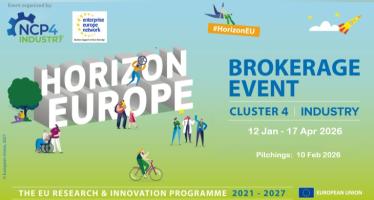
    Horizon Europe Industry 2026 Brokerage Event

    2026-01-12 -> 2026-04-17

    online

    This is the place to find partners for EU projects in industrial technologies and advanced manufacturing under Horizon Europe 2026 Cluster 4 Industry calls with deadlines 17 Mar 2026 (first stage of two-stage calls) and 21 Apr 2026 (single-stage calls).

    Horizon Europe Cluster 4 Info Days 2026

    2026-01-29 -> 2026-01-30

    online

    During the Info Days, representatives of the European Commission will present the 2026 call topics in Horizon Europe Cluster 4 and answer questions from the audience. You do not need to register to attend this online event, simply follow the live stream on the day.

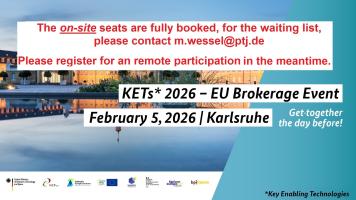
    KETs Brokerage Event 2026

    2026-02-04 -> 2026-02-05

    online

    Do you want to tackle the challenges of Industry, Manufacturing & Production, Materials, Digital/AI/Robotics, Batteries and Hydrogen? - Then use the unique opportunities of the KETs (Key Enabling Technologies) 2026 EU Brokerage Event on February 5, 2026 in Karlsruhe, Germany!

    Events are added by the ideal-ist NCP community and are hand-picked. If you would like to suggest an event, please contact idealist@ffg.at.

    Call topic timeline

    What phase of the topic timeline are we in? This timeline contains some suggestions on what are realistic actions you should or could take at this moment. The timeline is based on the information provided by the call topic.
    1. Work programme available

      - 10 months ago

      The call topics are published first in the Work Programme, which is available a while before the call opens. By following up the Work Programme publications, you can get a headstart.

    2. Publication date

      - 8 months ago

      The call was first imported in TopicTree.

    3. Opening date

      - 8 months ago

      The call opened for submissions.

    4. Closing date

      - 5 months ago

      Deadline for submitting a project.

    5. Time to inform applicants Estimate

      - 1 week ago

      The maximum time to inform applicants (TTI) of the outcome of the evaluation is five months from the call closure date.

    6. Today

    7. Sign grant agreement Estimate

      - 2 months from now

      The maximum time to sign grant agreements (TTG) is three months from the date of informing applicants.

    Funded Projects

    Loading...

    Project information comes from CORDIS (for Horizon 2020 and Horizon Europe) and will be sourced from F&T Portal (for Digital Europe projects)

    Bubbles

    This call topic is part of:

    Call document info

    This section will come soon and contain the scraped information from the call document, such as the expected impact, scope, and other relevant sections. In the meantime, you can find this information in the call text section or directly on the F&T portal. View on F&T portal