HORIZON-CL4-2027-04-DATA-08

Demand-side 3C pilot demonstrators on converged Telco Edge Cloud Infrastructure (IA) -

Related topics

Drag to rearrange · hover a topic or connection to preview why it's linked, click to pin that panel open

Topics in this graph

+6 more related topic(s) not shown

Bold node = current topic · node color = call status · hover for details, click to pin · smaller, lighter topics are two steps away

Call text (as on F&T portal)

View on F&T portal

Expected Outcome:

  • Demand-side driven validation of open orchestration platforms across the telco-cloud edge continuum unlocking notably the transformative value of AI for European businesses, driving business growth in multiple industries strategic for Europe.
  • Enabling the path towards sustainability and competitiveness of key vertical sectors in the EU, exploiting the innovative features of 3C/ telco-edge-cloud, including network features such as API (Application Program Interface) aggregation, slicing, automation, latency, security, ISAC (Integrated Sensing and Communication), reconfigurability, to significantly improve quality of service, resilience, sustainability and other performance parameters of digital communications.
  • The demand pilots will have a clear sector relevance, with one pilot addressing the future of smart mobility including the automotive sector.
  • A vibrant ecosystem around 3C/telco-edge-cloud infrastructure, targeting SMEs and start-ups to develop innovative services and new business models validation and marketplace exploitation strategies, as well as paths to commercialization or replicability.

Scope:

The term “Connected, Collaborative, Computing (3C) Network” refers to a telco-edge-cloud, secure multi-provider and multi-technology, communication system that hosts network functions and workloads for and beyond connectivity (e.g. 6G, AI Storage/Compute, networking, Security ISAC , and any other application or capability) as a service (aaS). Key features of the 3C/ telco-edge-cloud network include programmability, fast service creation, security and privacy, mobility, and service continuity across inter-domain deployments. 3C/ telco-edge-cloud networks enable innovative use cases for an EU Digital Market that integrate communication, collaboration and computing capabilities in competitive and sustainable business models that will reinforce EU competitiveness and contribute to digital sovereignty, in particular through the use of Open Internet Stack components. Resulting solutions should be available for use in the public sector (for instance for justice systems).

The 3C Network large-scale pilot funded under topic HORIZON-CL4-2025-03-DATA-08: Large-scale pilots for supply end-to-end infrastructures integrating device, network computing and communication capabilities for Telco Edge Cloud deployments, as a basis for Connected Collaborative Computing Networks (3C networks) (RIA) is setting up end-to-end integrated infrastructures and platforms, bringing together players from different segments of the connectivity and compute value chain and beyond. The main target is to research and validate the integration of device, network, cloud and edge computing, and communication capabilities for telco edge cloud deployments to realize a ubiquitous mesh of computing and communication resources. As a main outcome the supply side pilot establishes an open orchestration platform across the telco-cloud-edge continuum, exploits the transformative value of AI and builds on the integration of solutions developed by the Open Euro Stack.

Demand- side pilot demonstrators called in this topic will build on the above supply side large-scale pilot and integrate future domain-specific applications and services with an emerging European 3Cs/ telco-edge-cloud infrastructure, leveraging different network features. Key features will include security and privacy solutions offering resistance to emerging quantum threats (such as via post-quantum cryptography), mobility, and service continuity across inter-domain and multi-cloud deployments and ecosystems.

Up to two pilot demonstrators on below listed specific verticals are expected.

  • One pilot demonstrator focusing on Mobility covering specific areas of transport, logistics and the Automotive industry. The pilot should support the strategy as developed by the Connected and Autonomous Vehicle Alliance identified in the Automotive Action plan, in particular Pillars 3 (AI models) and 5 (Large-scale testing), which will be launched in 2025.
  • One pilot demonstrator focusing on another vertical sector such as energy, smart communities, industrial virtual worlds, health, agrifood or manufacturing.

They would be driven by a consortium including partners both from the demand (user) and infrastructure supply side. The pilot demonstrators should take advantage of open application interfaces, explore the possibilities of AI, “virtual worlds”, and other innovative technologies for practical implementation in the referred vertical domains. They should leverage combined investments in network infrastructure, computing and connectivity infrastructure as an enabler for more extensive set of digital innovation, with cognitive cloud computing and swarm intelligence, generative AI and LLM, as well as on-boarding of XR/AR technologies, being ranked most important.

Proposals are expected to detail a robust data governance model for the data generated and processed within the pilots. This model should address data sovereignty, interoperability with Common European Data Spaces, and alignment with principles from initiatives like Gaia-X. It should outline clear mechanisms for secure and compliant data sharing between the demand-side (users) and supply-side (infrastructure providers), establishing the trust necessary for a functional data economy on top of the 3C infrastructure.

Pilot demonstrators should demonstrate the evolution from virtualised and cloud-native network functions towards automated network operations enabling agile and green IoT-edge computing solutions and decentralised intelligence. They should also demonstrate benefits for infrastructure providers to operate networks more efficiently and move beyond traditional connectivity-service models to higher value-added services.

Demonstrations will respond to the ever more demanding processing power of AI through integration on-device level and changes triggered by GenAI affecting global communication infrastructures. Orchestration of workloads across the telco-cloud-edge continuum from distributed sensors and actuators to the edge and cloud is a crucial part of innovation as AI becomes more resource-intensive.

The pilot demonstrators should take into consideration the recommendations on user requirements from the advisory group of end users, as well as liaise with the collaboration and support action (CSA) funded under WP25 to bridge between the 3C/ telco-edge-cloud supply pilot funded under WP25 and the demand pilots funded under WP26-27.

The pilots should exploit in particular open APIs and open-source components as developed by the supply side pilot, e.g. including the use of capabilities to implement specific communication management services (e.g. Open RAN security, RIC VNF…), up-take of existing standards and relevant open-source projects (e.g., Sylva, ANUKET, Nephio, CAMARA, etc.).

The pilot demonstrators should include testing, validation and demonstration of prototypes of agile virtualised network functions combined with ubiquitous mesh of integrated devices, computing and communication resources in operational environments, ensuring security and privacy, protection also in the face of emerging quantum threats, energy efficiency, transparency and control of the ecological footprint, as well as sustainable artificial intelligence services.

The pilot demonstrators are expected to re-use as far as possible existing open-source frameworks, i.e. open-source software governed by communities of contributors, that will provide key technology components for the operation of the 3C/ telco-edge-cloud supply-side large scale pilot. These open-source frameworks should be made available to the Open Euro Stack Support for Scale.

The proposals should ensure a high degree of participation of stakeholders from the relevant vertical sectors, with a particular attention to the involvement of SMEs, scale-ups and start-ups.

The pilots should establish a high degree of relations and collaborate with complementary EU funded research activities, like the Smart Networks and Systems Joint Undertaking (SNS JU) projects, the “Empowering AI across the continuum” and the “Sovereign edge/cloud infrastructure” R&I areas, the PPP virtual worlds, CCAM partnership as well as support of SW-defined vehicle initiative under the Chips JU.

Technology Readiness Level - Technology readiness level expected from completed projects

Activities are expected to achieve TRL 6-8 by the end of the project – see General Annex B.

News flashes

Found 3 annotations in info base click to see
call topic details
Call status: Forthcoming
Opening date: 2026-11-17 (1 month from now)
Closing date: 2027-03-18 (5 months from now)
Procedure: single-stage

Budget: 38,000,000
Expected grants: 2
Contribution: 19,000,000 - 19,000,000
News flashes

This call topic has been appended 0 times by the EC with news.

Source information

Showing the latest information. Found 4 versions of this call topic in the F&T portal.

Information from

  • 2026-10-06_06-35-43
  • 2026-03-03_06-30-39
  • 2026-01-20_06-30-33
  • 2025-12-16_06-30-33

Check the differences between the versions.

Annotations

You must be logged in to add annotations
NCP training info
Added 2 days ago by Nico Deblauwe
EC White Paper - How to master Europe’s digital infrastructure needs? -> https://digital-strategy.ec.europa.eu/en/library/white-paper-how-master-europes-digital-infrastructure-needs
NCP knowledge
Added 3 months ago by Alrun Hauke
Check to see if there are currently relevant partner searches / partner offers on the Ideal-ist website: https://www.ideal-ist.eu/cooperation-profiles
Work Programme info
Added 8 months ago by Alrun Hauke
Eligibility for this topic is restricted under art. 22.5 of the Horizon Europe regulation (see [1]). Specifically, under art. 22.5, participation for projects under this call topic is restricted to legal entities established in EU member states, Iceland, Norway, Canada, Israel, the Republic of Korea, New Zealand, Switzerland and the United Kingdom. As part of the proposal submission for this topic, consortium members have to fill in the ownership control declaration (see [2]). The coordinator has to collect these forms from all partners and submit them as a single appendix to the proposal. The ownership control declarations are examined by the EC as part of the evaluation process. If it is found that a consortium partner is established in one of the eligible countries listed above, but controlled by an entity established in a non-eligible third country, the partner in question will be asked to provide a guarantee (see [3]) during grant agreement preparation which ensures that the EU's strategic interests are protected. The European Commission (EC) will examine this guarantee and - if approved - will forward it to the government of the eligible country of establishment of the partner for national approval. The partner in question may participate in the project only if both the EC and the respective national authority approve the guarantee. If either or both of these bodies do not approve the guarantee, the partner in question will be removed from the consortium during grant agreement preparation. Note that partners controlled directly or indirectly by China or an organisation established in China may not submit such guarantees. [1] https://eur-lex.europa.eu/eli/reg/2021/695/oj/eng [2] https://ec.europa.eu/info/funding-tenders/opportunities/docs/2021-2027/common/temp-form/af/ownership-control-declaration_en.docx [3] https://ec.europa.eu/info/funding-tenders/opportunities/docs/2021-2027/common/temp-form/gap/ownership-control-guarantee_en.docx

Events

Hand-picked events relevant to this call topic.

3 upcomings

Upcoming

Nov 12 2025

Horizon Europe Cluster 4 Digital Matchmaking Platform

Happening now
12 Nov 2025 - 22 Sep 2027 Online

Find your collaboration partners for EU projects in the digital domain of Cluster 4 here!

Oct 14 2026

Horizon Europe Cluster 4 Info Days for 2027 Calls

in 4 days
14 Oct - 15 Oct 2026 Online

The Horizon Europe Info Days for Cluster 4 will take place online as usual. Participants can ask questions via slido during the event. Representatives of the European Commission will present the 2027 call topics from Cluster 4 and relevant parts of the horizontal work programme part.

Feb 25 2027

Ideal-ist Full Proposal Check 2027

in 138 days
25 Feb - 3 Mar 2027 07:00 - 15:00 Online

Are you targeting any of the Horizon Europe Cluster 4 topics with a digital technologies focus and a call deadline in March 2027? Are you coordinating a proposal for any of these topics?

Then this may be for you: To support you in preparing excellent proposals, Ideal-ist is organising a Full Proposal Check for the Horizon Europe Cluster 4 Digital call topics with a deadline in March 2027.

This is a great opportunity to receive free, in-depth advice from actual Horizon Europe evaluators before you submit your proposal to the European Commission for formal evaluation!

To find out more about how our Full Proposal Check events work, click here.

Timing for the FPC 2027

Registration deadline: 18 February 2027
Submission of advanced draft: 18 February 2027
Experts review: 19 - 24 February 2027
Feedback sessions: 25 February - 3 March 2027

Please note: The platform link for registration will be provided shortly!

For more information about the Full Proposal Check, please email salko@unmo.ba

Past

Sep 30 2026

European Big Data Value Forum (EBDVF) 2026

Past
30 Sep - 1 Oct 2026 Galway, Ireland

The European Big Data Value Forum (EBDVF) brings together industry professionals, business developers, researchers and policy-makers from all over Europe and other regions of the world to advance policy actions and industrial and research activities in the areas of Data and AI.

Jun 22 2026

Bridging the Horizon - AI, Data and Robotics

Past
22 Jun 2026 10:00 - 12:00 Online

Bridging the Horizon is an exclusive virtual matchmaking series designed to catalyse the formation of high-level consortia in Horizon Europe. The programme serves as the strategic first stage of the wider Bridges 2026 hybrid initiative, specifically targeting the Digital: AI, Robotics & Data cluster.

This online event brings together a hand-picked group of researchers, corporate executives, and industry professionals from Europe and Israel to translate technical expertise into competitive project proposals. 

May 5 2026

Data Week 2026

Past
5 May - 6 May 2026 Online

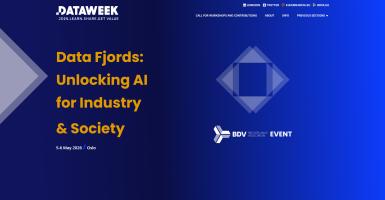
Data Week 2026 will be a 2-day physical event taking place in Oslo, Norway between 5-6 May. The event will be organised by the Big Data Value Association in collaboration with the following BDVA members: IFE (Institute for Energy technology), NTNU (Norwegian University of Science and Technology), SINTEF and Western Norway Research Institute. 

Events are added by the ideal-ist NCP community and are hand-picked. Would you like to suggest an event? Contact idealist@ffg.at.

Timeline

Track where this call stands in its lifecycle, from work programme to grant signature, and see what's likely to happen next.

Work programme published · 17 Sep 2026 (3 weeks ago)

Next: Call opens, 1 month from now (17 Nov 2026)

Today

Call published

16 Dec 2025

Work programme published

17 Sep 2026 · est.

Call opens

17 Nov 2026

Call closes

18 Mar 2027

Outcome expected

18 Aug 2027 · est.

Grant agreement signed

18 Nov 2027 · est.

Preparation Open for submission Evaluation Grant preparation Not yet reached
  1. Call published

    16 Dec 2025 · 9 months ago

    This topic was first published in TopicTree.

  2. Work programme published Estimated

    17 Sep 2026 · 3 weeks ago

    Topics are listed in the Work Programme before the call opens. Spotting this early gives you a head start on partner search and proposal planning.

  3. Call opens

    17 Nov 2026 · 1 month from now

    Submissions can be made from this date.

  4. Call closes

    18 Mar 2027 · 5 months from now

    Deadline to submit a proposal.

  5. Outcome expected Estimated

    18 Aug 2027 · 10 months from now

    The maximum time to inform applicants of the evaluation outcome is five months after the call closes.

  6. Grant agreement signed Estimated

    18 Nov 2027 · 1 year from now

    The maximum time to sign the grant agreement is three months after applicants are informed of the outcome.

Funded Projects

Loading...

Project information comes from CORDIS (for Horizon 2020 and Horizon Europe) and will be sourced from F&T Portal (for Digital Europe projects)

Ecosystem bubbles

This call topic is part of the following thematic bubbles.

1 bubble

Call document info

This section will come soon and contain the scraped information from the call document, such as the expected impact, scope, and other relevant sections. In the meantime, you can find this information in the call text section or directly on the F&T portal. View on F&T portal