HORIZON-CL4-2026-04-DIGITAL-EMERGING-11

Grand Challenge on Quantum Sensors for Inertial Navigation - CANCELLED -

Call text (as on F&T portal)

View on F&T portal

Expected Outcome:

Expected Outcome: This topic is the first phase of a two-phase competitive structure supported by Horizon Europe, implemented via a Coordination and Support Action (CSA) in close collaboration with the European Investment Bank (EIB).

  • Phase 1 (this topic): A CSA focused on readiness-analysis in terms of exploitation and investments, benchmarking the commercial viability of quantum enabled navigation systems. The aim is to deliver concrete outputs that improve the conditions for use of the supported projects through credible technical, industrialisation and financial roadmaps, validated against investor requirements (e.g. EIB, InvestEU). Activities also include analyses of investor-readiness and supply-chain sovereignty.
  • Phase 2: For further information, see the indirectly managed action “HORIZON-CL4 Quantum Top-Up to InvestEU: Grand Challenge Phase 2” in the Cluster 4 part of the Horizon Europe 2026/2027 Work Programme. This CSA is designed to allow the best possible application in Phase 2 and the current CSA results may therefore inform applications by beneficiaries to investment support managed by the EIB under InvestEU (separate procedures).

Under Phase 1 projects are expected to establish a comprehensive technical and financial roadmap that demonstrates the potential of the proposed Q-INS solutions, and at least deliver evidence-based design and benchmarking packages for reduced-scale systems ( such as documentation, test/benchmark reports and evidence of pre-existing or externally financed prototypes) in one of the following two categories:

  • Category 1 (cold-atoms Q-INS): Q-INS based on cold-atom interferometry (or other technology of at least equivalent performance) featuring long-term navigation accuracy (<10 m/hour) due to reduced drift with respect to commercial Inertial Measurement Units (IMUs). End-user requirements together with documented benchmark evidence from existing or externally financed prototypes will be collected for demonstrations in maritime or aviation applications.
  • Category 2 (Chip-scale Q-INS): Low C-SWAP Q-INS measuring acceleration, rotation rate, and/or magnetic field, aimed at the implementation of chip-scale sensors based on defect centers and vacancies in crystals or on warm atomic vapours (including nuclear magnetic resonance), for applications e.g. in small satellites, UAVs, and autonomous transport.

Proposals should target systems that are already sufficiently mature to enable credible benchmarking and industrial road-mapping. Specific expected outcomes include:

  • A detailed technical roadmap, including system architecture, integration strategy, performance milestones, risk assessments and industrialisation plan for scalable production
  • The industrialisation plan should be validated in conjunction with the EIB requirements, including commercialization timelines, and should include at least the following:
    • Detailed Q-INS architecture based on quantum sensing techniques hybridised with classical IMUs,
    • Compliance assessment for SWaP-C requirements, environmental resilience, and real-world integration,
    • An assessment of dependencies on non-EU suppliers of critical components and proposal of effective mitigation measures in view of a sovereign supply chain,
    • Potential list of end-users to capture system requirements and use-case constraints
  • A comprehensive financial roadmap and viability assessment covering business models, market analyses, commercialization pathways, revenue projections and investment criteria
  • Documented lab-validation/benchmarking of an existing or externally financed prototype (no EU funding of R&I or prototype development in this CSA), with preliminary benchmark results.
  • An application strategy identifying target sectors (maritime, aviation, space, autonomous systems) and quantifiable advantages over classical IMUs.

Scope:

The Grand Challenge on Quantum Sensors for Inertial Navigation aims to advance the development of quantum-enabled navigation systems for use in GNSS-denied or contested environments. Q-INS combines quantum sensors with classical inertial measurement subsystems to deliver reliable, resilient, and sovereign positioning capabilities. The topic supports the EU’s ambition to strengthen technological sovereignty in strategic navigation infrastructures, aligned with the objectives of the STEP and the Digital Decade.

Under this topic (Phase 1), projects are expected to deliver a comprehensive technical, industrialisation, and financial roadmap, including criteria for investment readiness, bankability, risk assessment, and scalability, thereby laying the groundwork for future investments via EU financial instruments under InvestEU, which benefits from a dedicated top-up from Horizon Europe for this purpose[1].

Under Phase 1, Expressions of Interest from potential end-user partners are strongly encouraged. Tailored advisory services from EIB Advisory may support financial structuring to prepare for Phase 2.

Projects funded under this action are expected to span approximately six months, with an EU contribution up to EUR 0.5 million.

This topic is cancelled. The cancellation follows the adoption of Council Regulation (EU) 2026/150 of 16 January 2026 amending Regulation (EU) 2021/1173 on establishing the European High Performance Computing Joint Undertaking (‘EuroHPC JU’), which enlarged the mandate of EuroHPC JU to encompass, inter alia, quantum technologies.

[1] HORIZON-CL4 Indirectly managed action “Quantum Top-Up to InvestEU: Grand Challenge Phase 2”

News flashes

2026-10-09

PROPOSAL NUMBERS

Call HORIZON-CL4-2026-04 has closed on 15.04.2026

312 proposals have been submitted.

The breakdown per topic is:

HORIZON-CL4-2026-04-DATA-02

31

HORIZON-CL4-2026-04-DATA-03

6

HORIZON-CL4-2026-04-DATA-06

63

HORIZON-CL4-2026-04-DIGITAL-EMERGING-14

1

HORIZON-CL4-2026-04-DIGITAL-EMERGING-15

2

HORIZON-CL4-2026-04-DIGITAL-EMERGING-17

1

HORIZON-CL4-2026-04-HUMAN-01

105

HORIZON-CL4-2026-04-HUMAN-02

32

HORIZON-CL4-2026-04-DIGITAL-EMERGING-01

4

HORIZON-CL4-2026-04-DIGITAL-EMERGING-08

8

HORIZON-CL4-2026-04-DIGITAL-EMERGING-09

41

HORIZON-CL4-2026-04-DIGITAL-EMERGING-19

18

Evaluation results are expected to be communicated in July 2026.

2026-10-09

The European Commission intends to cancel this topic. As of today, therefore, the submission platform for this topic is no longer accessible.

The envisioned cancellation follows the adoption of COUNCIL REGULATION (EU) 2026/150 of 16 January 2026 amending Regulation (EU) 2021/1173 on establishing the European High Performance Computing Joint Undertaking, which enlarged the mandate of EuroHPC joint undertaking to encompass, inter alia, quantum technologies. Consequently, EuroHPC JU may include in its own work programme for 2026 similar topics and potentially open them for submission in the second half of this year. Any relevant information will be made available by EuroHPC JU and information on all calls decided under the EuroHPC work programmes is also available here. Applicants may also refer to the EuroHPC JU website.

The cancellation is subject to the update of the Work Programme, once all necessary procedural steps for its adoption are finalised. It is currently foreseen in fourth quarter of 2026.

2026-10-09
The submission session is now available for: HORIZON-CL4-2026-04-DIGITAL-EMERGING-18, HORIZON-CL4-2026-04-DIGITAL-EMERGING-17, HORIZON-CL4-2026-04-HUMAN-02, HORIZON-CL4-2026-04-DIGITAL-EMERGING-01, HORIZON-CL4-2026-04-DATA-03, HORIZON-CL4-2026-04-DIGITAL-EMERGING-08, HORIZON-CL4-2026-04-DATA-06, HORIZON-CL4-2026-04-DATA-02, HORIZON-CL4-2026-04-DIGITAL-EMERGING-12, HORIZON-CL4-2026-04-DIGITAL-EMERGING-09, HORIZON-CL4-2026-04-DIGITAL-EMERGING-11, HORIZON-CL4-2026-04-DIGITAL-EMERGING-19, HORIZON-CL4-2026-04-HUMAN-01, HORIZON-CL4-2026-04-DIGITAL-EMERGING-14, HORIZON-CL4-2026-04-DIGITAL-EMERGING-15

Found 4 annotations in info base click to see
call topic details
Call status: Closed
Opening date: 2026-01-15 (8 months ago)
Closing date: 2026-04-15 (5 months ago)
Procedure: single-stage

Budget: 0
Expected grants: 0
News flashes

This call topic has been appended 3 times by the EC with news.

  • 2026-10-09
    proposal numbers call horizon-cl4-2026-...
  • 2026-10-09
    the european commission intends to cance...
  • 2026-10-09
    the submission session is now available...
Source information

Showing the latest information. Found 9 versions of this call topic in the F&T portal.

Information from

  • 2026-10-08_06-47-44
  • 2026-04-16_06-32-58
  • 2026-04-10_06-33-02
  • 2026-03-03_06-32-34
  • 2026-02-18_06-32-02
  • 2026-01-20_06-30-58
  • 2026-01-15_06-30-59
  • 2026-01-14_06-30-49
  • 2025-12-16_06-30-54

Check the differences between the versions.

Annotations

You must be logged in to add annotations
EC infoday info
Added 7 months ago by Alrun Hauke
Watch the recording from the Cluster 4 Info Day session here: https://youtu.be/jmIUKQvP850
EC infoday info
Added 8 months ago by Alrun Hauke
According to information provided at the Cluster 4 Info Days 2026, the term "EU-owned start-up" in the context of this call topic refers to start-ups with ownership from within the EU memberstates, Iceland or Norway. Due to the Horizon Europe–InvestEU “marriage”, phase 2 is an InvestEU/EIB instrument and therefore requires EU-owned beneficiaries (plus Iceland/Norway). Non-EU27 start-ups may participate in phase 1, but then cannot continue to phase 2.
EC infoday info
Added 8 months ago by Alrun Hauke
According to information provided at the Cluster 4 Info Days 2026, phase 1 of the grand challenge is a short, company-focused CSA targeting SME/start-up monobeneficiaries to build a credible technical + financial roadmap (incl. benchmarking approach) for quantum inertial navigation. It is positioned as the entry phase of a two-step pipeline that can lead to an InvestEU/EIB phase 2 scaling instrument (convertible loan) aimed at real-world deployment and scalability. Proposals should target either cold-atom navigation concepts (high accuracy, end-user co-design, demonstration in relevant platforms) or chip-scale approaches (e.g., defect centres / warm vapours) with strong constraints on cost, size and power.
Work Programme info
Added 8 months ago by Alrun Hauke
Eligibility for this topic is restricted under art. 22.5 and art. 22.6 of the Horizon Europe regulation (see [1]). Specifically, under art. 22.5, participation for projects under this call topic is restricted to legal entities established in EU member states, Iceland, Norway, Canada, Israel, the Republic of Korea, New Zealand, Switzerland and the United Kingdom. Under art. 22.6, any entities considered high-risk suppliers of mobile network communication equipment are expressly excluded from participating. This currently concerns companies Huawei and ZTE (see [2]) as well as any entities fully or partially owned / controlled by them. As part of the proposal submission for this topic, consortium members have to fill in the ownership control declaration (see [3]). The coordinator has to collect these forms from all partners and submit them as a single appendix to the proposal. The ownership control declarations are examined by the EC as part of the evaluation process. If it is found that a consortium partner is established in one of the eligible countries listed above, but controlled by an entity established in a non-eligible third country, the partner in question will be asked to provide a guarantee (see [4]) during grant agreement preparation which ensures that the EU's strategic interests are protected. The European Commission (EC) will examine this guarantee and - if approved - will forward it to the government of the eligible country of establishment of the partner for national approval. The partner in question may participate in the project only if both the EC and the respective national authority approve the guarantee. If either or both of these bodies do not approve the guarantee, the partner in question will be removed from the consortium during grant agreement preparation. [1] https://eur-lex.europa.eu/eli/reg/2021/695/oj/eng [2] https://digital-strategy.ec.europa.eu/en/library/communication-commission-implementation-5g-cybersecurity-toolbox [3] https://ec.europa.eu/info/funding-tenders/opportunities/docs/2021-2027/common/temp-form/af/ownership-control-declaration_en.docx [4] https://ec.europa.eu/info/funding-tenders/opportunities/docs/2021-2027/common/temp-form/gap/ownership-control-guarantee_en.docx

Events

Hand-picked events relevant to this call topic.

1 upcoming

Upcoming

Nov 12 2025

Horizon Europe Cluster 4 Digital Matchmaking Platform

Happening now
12 Nov 2025 - 22 Sep 2027 Online

Find your collaboration partners for EU projects in the digital domain of Cluster 4 here!

Past

Feb 4 2026

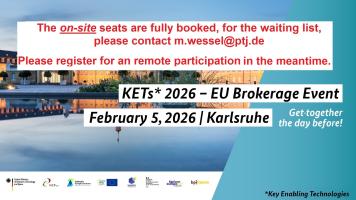
KETs Brokerage Event 2026

Past
4 Feb - 5 Feb 2026 Karlsruhe, Germany

Do you want to tackle the challenges of Industry, Manufacturing & Production, Materials, Digital/AI/Robotics, Batteries and Hydrogen? - Then use the unique opportunities of the KETs (Key Enabling Technologies) 2026 EU Brokerage Event on February 5, 2026 in Karlsruhe, Germany!

Jan 29 2026

Horizon Europe Cluster 4 Info Days 2026

Past
29 Jan - 30 Jan 2026 Online

During the Info Days, representatives of the European Commission will present the 2026 call topics in Horizon Europe Cluster 4 and answer questions from the audience. You do not need to register to attend this online event, simply follow the live stream on the day.

Events are added by the ideal-ist NCP community and are hand-picked. Would you like to suggest an event? Contact idealist@ffg.at.

Timeline

Track where this call stands in its lifecycle, from work programme to grant signature, and see what's likely to happen next.

Outcome expected · 15 Sep 2026 (3 weeks ago)

Next: Grant agreement signed, 2 months from now (15 Dec 2026, estimated)

Today

Work programme published

15 Nov 2025 · est.

Call published

16 Dec 2025

Call opens

15 Jan 2026

Call closes

15 Apr 2026

Outcome expected

15 Sep 2026 · est.

Grant agreement signed

15 Dec 2026 · est.

Preparation Open for submission Evaluation Grant preparation Not yet reached
  1. Work programme published Estimated

    15 Nov 2025 · 10 months ago

    Topics are listed in the Work Programme before the call opens. Spotting this early gives you a head start on partner search and proposal planning.

  2. Call published

    16 Dec 2025 · 9 months ago

    This topic was first published in TopicTree.

  3. Call opens

    15 Jan 2026 · 8 months ago

    Submissions can be made from this date.

  4. Call closes

    15 Apr 2026 · 5 months ago

    Deadline to submit a proposal.

  5. Outcome expected Estimated

    15 Sep 2026 · 3 weeks ago

    The maximum time to inform applicants of the evaluation outcome is five months after the call closes.

  6. Grant agreement signed Estimated

    15 Dec 2026 · 2 months from now

    The maximum time to sign the grant agreement is three months after applicants are informed of the outcome.

Funded Projects

Loading...

Project information comes from CORDIS (for Horizon 2020 and Horizon Europe) and will be sourced from F&T Portal (for Digital Europe projects)

Call document info

This section will come soon and contain the scraped information from the call document, such as the expected impact, scope, and other relevant sections. In the meantime, you can find this information in the call text section or directly on the F&T portal. View on F&T portal